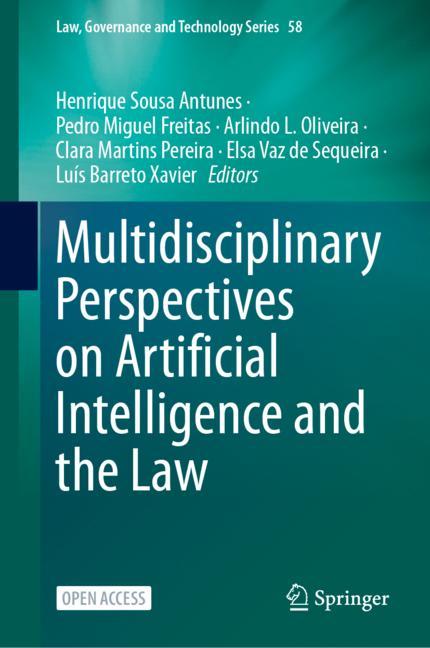
Law, governance and technology series, 2352-1902 ; volume 58
표준번호/부호
ISBN: 9783031412639 ISBN: 9783031412646
제어번호
MONO22024000008760
주기사항
Includes bibliographical references.
연계정보
외부기관 원문
목차보기
Part I Scientific, Technological and Societal Achievements in Artificial Intelligence Artificial Intelligence: Historical Context and State of the Art 3 Arlindo L. Oliveira and Mário A. T. Figueiredo The Impact of Language Technologies in the Legal Domain 25 Isabel Trancoso, Nuno Mamede, Bruno Martins, H. Sofia Pinto, and Ricardo Ribeiro Societal Implications of Recommendation Systems: A Technical Perspective 47 Joana Gonçalves-Sá and Flávio Pinheiro Data-Driven Approaches in Healthcare: Challenges and Emerging Trends 65 Ana Teresa Freitas Security and Privacy 81 Miguel Correia and Luís Rodrigues Part II Ethical and Legal Challenges in Artificial Intelligence Before and Beyond Artificial Intelligence: Opportunities and Challenges 107 M. Patrão Neves and A. Betâmio de Almeida Autonomous and Intelligent Robots: Social, Legal and Ethical Issues 127 Pedro U. Lima and Ana Paiva The Ethical and Legal Challenges of Recommender Systems Driven by Artificial Intelligence 141 Eduardo Magrani and Paula Guedes Fernandes da Silva Metacognition, Accountability and Legal Personhood of AI 169 Beatriz A. Ribeiro, Helder Coelho, Ana Elisabete Ferreira, and João Branquinho Artificial Intelligence and Decision Making in Health: Risks and Opportunities 187 Márcia Santana Fernandes and José Roberto Goldim The Autonomous AI Physician: Medical Ethics and Legal Liability 207 Mindy Nunez Duffourc and Dominick S. Giovanniello Ethical Challenges of Artificial Intelligence in Medicine and the Triple Semantic Dimensions of Algorithmic Opacity with Its Repercussions to Patient Consent and Medical Liability 229 Rafaella Nogaroli and José Luiz de Moura Faleiros Júnior Part III The Law, Governance and Regulation of Artificial Intelligence Dismantling Four Myths in AI & EU Law Through Legal Information ‘About’ Reality 251 Ugo Pagallo AI Modelling of Counterfactual Thinking for Judicial Reasoning and Governance of Law 263 Luís Moniz Pereira, Francisco C. Santos, and António Barata Lopes Judicial Decision-Making in the Age of Artificial Intelligence 281 Willem H. Gravett Liability for AI Driven Systems 299 Ana Taveira da Fonseca, Elsa Vaz de Sequeira, and Luís Barreto Xavier Risks Associated with the Use of Natural Language Generation: Swiss Civil Liability Law Perspective 319 Marcel Lanz and Stefan Mijic AI Instruments for Risk of Recidivism Prediction and the Possibility of Criminal Adjudication Deprived of Personal Moral Recognition Standards: Sparse Notes from a Layman 339 Pedro Garcia Marques The Relevance of Deepfakes in the Administration of Criminal Justice 351 Dalila Durães, Pedro Miguel Freitas, and Paulo Novais Antitrust Law and Coordination Through Al-Based Pricing Technologies 371 Maria José Schmidt-Kessen and Max Huffman The “Artificial Intelligence Act” Proposal on European e-Justice Domains Through the Lens of User-Focused, User-Friendly and Effective Judicial Protection Principles 397 Joana Covelo de Abreu The European Union’s Approach to Artificial Intelligence and the Challenge of Financial Systemic Risk 415 Anat Keller, Clara Martins Pereira, and Martinho Lucas Pires Regulating AI: Challenges and the Way Forward Through Regulatory Sandboxes 441 Katerina Yordanova and Natalie Bertels
이용현황보기
Multidisciplinary perspectives on artificial intelligence and the law 이용현황 표 - 등록번호, 청구기호, 권별정보, 자료실, 이용여부로 구성 되어있습니다.
등록번호
청구기호
권별정보
자료실
이용여부
0003125013
LM 343.0999 -A24-12
서울관 법률정보센터(206호)
이용가능
출판사 책소개
This open access book presents an interdisciplinary, multi-authored, edited collection of chapters on Artificial Intelligence ('AI') and the Law. AI technology has come to play a central role in the modern data economy. Through a combination of increased computing power, the growing availability of data and the advancement of algorithms, AI has now become an umbrella term for some of the most transformational technological breakthroughs of this age. The importance of AI stems from both the opportunities that it offers and the challenges that it entails. While AI applications hold the promise of economic growth and efficiency gains, they also create significant risks and uncertainty. The potential and perils of AI have thus come to dominate modern discussions of technology and ethics - and although AI was initially allowed to largely develop without guidelines or rules, few would deny that the law is set to play a fundamental role in shaping the future of AI.As the debate over AI is far from over, the need for rigorous analysis has never been greater. This book thus brings together contributors from different fields and backgrounds to explore how the law might provide answers to some of the most pressing questions raised by AI. An outcome of the Catolica Research Centre for the Future of Law and its interdisciplinary working group on Law and Artificial Intelligence, it includes contributions by leading scholars in the fields of technology, ethics and the law.?

 대표어
대표어